
In Spain, the nativity scene has long been as much a part of the festive season as the Three Kings are on 6 January. The Christmas tree came along later – and brought new traditions with it. Today, the two often stand side by side in harmony. Yet their significance has changed.
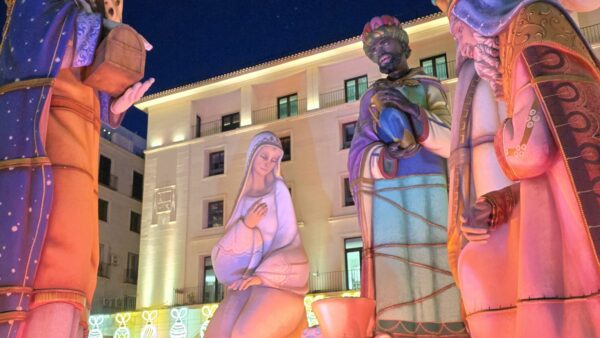
Mary, Joseph and the baby Jesus stand in the stable, the shepherds are gathered with their sheep, and the Three Wise Men are already on their way. Next to them, a Christmas tree is lit up, with presents waiting beneath it. What is now taken for granted on the Costa Blanca as a single tradition actually stems from two different Christmas traditions. Whilst the nativity scene was the most important Christmas symbol in Spanish families for centuries, the decorated tree began its triumphant march from Central Europe. It has now become a fixture practically everywhere. But has it really supplanted the nativity scene?
When Francis of Assisi had the Nativity re-enacted in Greccio, Italy, in 1223, his aim was to bring the Christmas story closer to the people. Using a manger, hay, an ox and a donkey, he brought the biblical narrative to life. Nativity figures as we know them today were not yet in use at that time. Over the centuries, this developed into an elaborate tradition. In Italy in particular, entire nativity scenes emerged, featuring houses, workshops, markets and scenes of everyday life. Such displays first reached Spain mainly through church institutions and aristocratic households. The art of nativity scenes received a decisive boost in the 18th century from King Charles III, who had previously reigned in Naples and brought the local tradition with him. What began as a religious depiction increasingly became a family custom. And the Spanish certainly did not limit themselves to a simple stable.
Anyone looking for a traditional Spanish nativity scene, a Belén, on closer inspection, reveals far more than just the birth of Christ. Bread is being baked, water carried, laundry washed and goods traded at the market. Amongst the biblical figures are farmers, craftsmen and traders, sometimes even people in regional costume. The nativity scene tells not only of Bethlehem, but also of the lives of the people who create them. The province of Alicante demonstrates just how far back this tradition stretches. The Museo de Belenes in Alicante is entirely dedicated to the art of nativity scenes. In Alcoy, the historic puppet theatre Betlem de Tirisiti at Christmas time. There, the Holy Family and biblical figures come face to face with local characters, scenes from everyday life and folk humour. And then there is a particularly quirky figure from the Catalan nativity scene tradition: the Caganer, who is relieving himself with his trousers down. Whilst this may not sound very Christmassy, it has been a feature of nativity scenes there for generations. However, it is not a common feature of Spanish nativity scenes, nor is it a typical tradition of the Costa Blanca. Nativity scenes have simply never been exclusively devotional; they were also allowed to depict everyday life.
The tradition of decorating a Christmas tree developed primarily in German-speaking Central Europe. References to such customs can be found as early as the 16th century. Initially, apples, nuts and biscuits were hung from the branches; later, candles were added, and finally electric lights. In the 19th century, the Christmas tree spread from European aristocratic households and middle-class families to other countries. In Spain, the Russian aristocrat Sofía Troubetzkoy is regarded as a key pioneer. In 1870, she had a decorated Christmas tree set up in her Madrid palace. However, isolated instances of Christmas trees had already been documented earlier. Over the course of the 20th century, the custom became increasingly popular in Spain. The tree had one decisive advantage: it could be decorated independently of any specific Christmas story and became the focal point of the gift-giving. This also changed the Spanish festive season. Traditionally, it was not Father Christmas or the Christ Child who brought the presents here, but the Three Kings on 6 January. Today, in many families, children receive presents at Christmas and get to look forward to another round of presents in early January. Father Christmas and the Three Wise Men share responsibility, so to speak.
The fact that Christmas trees are now ubiquitous in shopping centres, hotels, restaurants and public spaces does not mean that the nativity scene has disappeared. Its role has expanded. For devout Christians, the birth of Jesus remains the central focus. For others, the Belén above all, a childhood memory, a family tradition or a piece of regional culture. Spain explained that Belenismo In 2022, it was recognised as an Intangible Cultural Heritage of Humanity. In addition to its religious roots, the recognition also honours the craftsmanship, traditional techniques and social significance of the custom. The symbolism of the Christmas tree has also evolved. What began as a custom with Christian and older evergreen symbols has become an international symbol of the festive season. You need neither belong to a church nor know the Christmas story to enjoy an illuminated Christmas tree.
It is particularly on the Costa Blanca, where Spanish families and international residents observe different customs, that these Christmas traditions come together. Whilst for some the nativity scene and Three Kings’ Day are an integral part of the festivities, others associate Christmas primarily with the decorated tree and the exchange of presents on Christmas Eve. Many families have long since adopted elements from both traditions. Perhaps this is why the nativity scene has retained its place despite the popularity of the Christmas tree. The tree brings lights, presents and a festive atmosphere. The nativity scene tells a story that has been passed down through the generations – and now also appeals to people for whom Christmas is no longer exclusively a religious festival. In any case, the Christmas tree has not supplanted the nativity scene. Both have found their place. The only thing that remains a subject of lively debate is whether the Baby Jesus should be placed in the nativity scene before Christmas Eve and whether the Three Wise Men are allowed to arrive as early as the beginning of December.
From monumental figures to intricately detailed miniature worlds and historical nativity plays: these ten nativity scenes demonstrate just how diverse the Christmas tradition is in the region.
ADVERTISEMENT