
ADVERTISEMENT

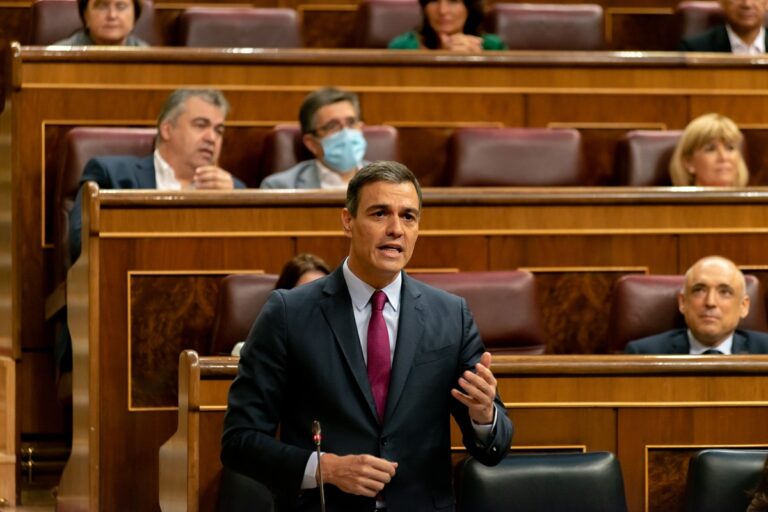
Shortly before Parliament’s summer recess, the Spanish government suffered a significant setback. Congress passed a motion tabled by the conservative PP calling on Prime Minister Pedro Sánchez to consider a vote of confidence should he fail to call a general election.
The PP, Vox, UPN and Junts provided the majority. Junts’ support, in particular, carries significant political weight. Carles Puigdemont’s Catalan party is not part of the government, but has been crucial to Sánchez on several occasions since the start of the parliamentary term whenever votes in Congress were close.
Legally speaking, the vote does not bind Sánchez to anything. In Spain, a vote of confidence cannot be forced by Parliament; it is at the discretion of the head of government. Politically, however, the vote is more than just a symbolic jab. It shows that Sánchez can no longer count on his previous coalition partners to secure a majority on key issues.
The PP’s motion was originally worded in stronger terms. Two points – the call for immediate new elections and for the resignation of the entire government – were not allowed to be debated by the Congress Presidium.
However, the vote was on the call for Sánchez to consider a vote of confidence. Another motion, which uses corruption investigations involving the Socialists to mount a political attack on the Prime Minister, also secured a majority.
The PP sees this as proof that Sánchez no longer has a stable parliamentary base. The Socialists describe it as a political manoeuvre with no legal consequences. Both views capture part of the situation: the motion does not bring down the government. However, it does highlight just how limited its room for manoeuvre has become.
It comes as no surprise that PP and Vox are voting against Sánchez. Junts is the deciding factor. The party has shown on several occasions in recent months that its support cannot be taken to mean a permanent majority for the government.
This is a problem for Sánchez. His government relies on shifting alliances with several regional and pro-independence parties. If Junts sides with the right-wing bloc on key votes, every major piece of legislation becomes a new test of resilience.
This became apparent on the very same day. A royal decree from the Ministry of Transport allocating around 1,000 million euros to Renfe, state-owned ports and Salvamento Marítimo was also rejected. Junts, along with the PP, Vox and UPN, voted against the government on this issue as well.
Nevertheless, the session did not end in a complete defeat for Sánchez. Congress extended the „Verano Joven“ scheme, which offers young people aged between 18 and 30 substantial discounts on train and bus travel during the summer.
In addition, two further initiatives made progress: the ban on so-called LGBTIQ+ conversion therapies is to be made more stringent under criminal law. Furthermore, the process of transferring the Galician AP-9 motorway to the regional government of Galicia has been set in motion.
That sums up the current situation in Madrid quite accurately: the government can still push through individual projects. However, it can no longer rely on its parliamentary support holding firm.
The Spanish Parliament’s regular session ends in June. Normal business resumes in September. This means that the parliamentary summer recess normally covers July and August.
Politically speaking, this does not necessarily mean a real break. Extraordinary sessions may be convened if requested by the government, the Permanent Deputation or an absolute majority in either chamber. This means that, even in summer, Madrid remains capable of taking action during times of tension.
For the time being, this vote will not change anything in terms of everyday life on the Costa Blanca. There will be no automatic snap election, no change of government and no legal obligation for Sánchez to call a vote of confidence.
Nevertheless, this development is also relevant to the Valencian Community. In Valencia, the PP is in power, with Juanfran Pérez Llorca at the head of the Generalitat. Its majority in the Valencian Parliament (Les Corts Valencianes) is based on the PP and Vox. The PSOE is the opposition party there, followed by Compromís.
This means that the political lines between Madrid and Valencia are clearly drawn: in the capital, a minority Socialist government is under pressure; in the Comunidad Valenciana, the PP is in power with the support of Vox. This situation also shapes the debates on competences, funding and state investment.
For readers on the Costa Blanca, this does not mean that specific projects will now automatically be blocked. It does mean, however, that when the political situation in Madrid is unstable, it becomes more difficult to plan for the long term. This applies in particular to projects where the central government and the region must work together.
Following the vote, PP leader Alberto Núñez Feijóo left open the question of whether he would table a motion of no confidence against Sánchez. Such a motion would only succeed in Spain if an alternative head of government were elected at the same time.
So Feijóo would need not only a majority against Sánchez, but also a majority for himself. That is precisely the tricky bit.
Spain is therefore not on the immediate brink of a change of government. However, the parliament is heading into the summer in a weakened state. Sánchez remains in office, but his majorities have become less reliable.
Source note: This is based on reports from El País, Cadena SER, RTVE and elDiario.es, information provided by the Corts Valencianes, and Article 73 of the Spanish Constitution.
ADVERTISEMENT