

ADVERTISEMENT
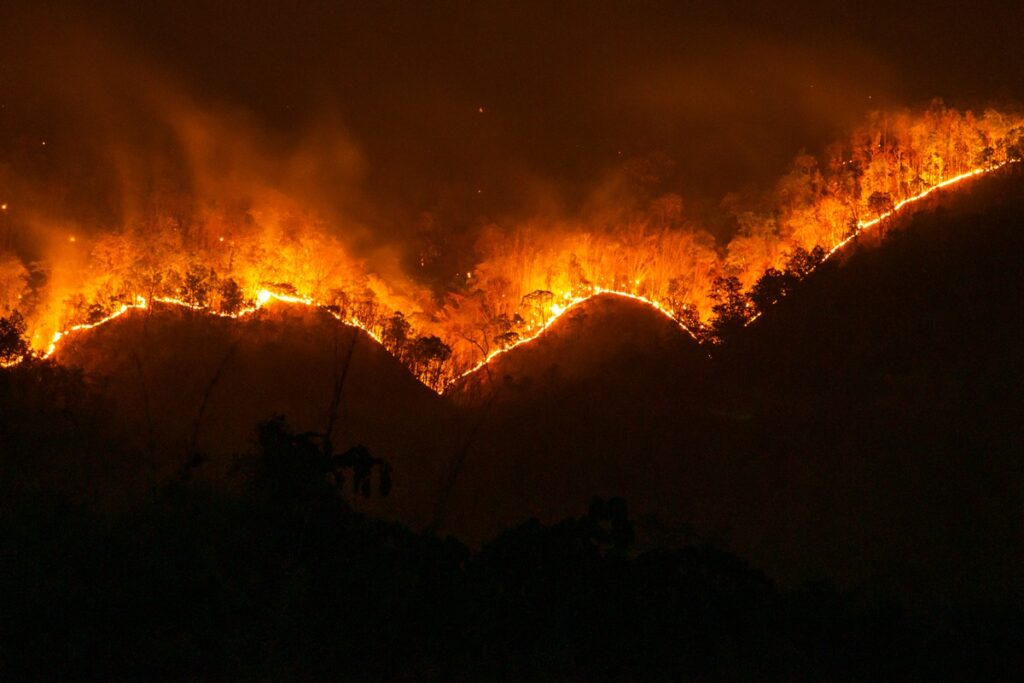
The wildfire broke out on Thursday in the east of the province of Almería, in the area between Los Gallardos and Bédar. According to Spanish media reports, the death toll rose to twelve on Friday. Eight people were injured, several of them seriously. The number of people missing was initially reported to be as many as 23. According to preliminary figures, around 3,150 hectares of land were affected.
Hundreds of personnel from the fire service, INFOCA, the Guardia Civil, the emergency services and the military emergency unit (UME) were deployed. Heat, wind, dry vegetation and difficult-to-access terrain made the fire-fighting efforts particularly challenging. The fire swept through a landscape of barrancos, ramblas, rural access roads, scattered houses and settlements on the edge of natural areas.
The circumstances surrounding several of the deaths are particularly harrowing. According to initial reports, victims were found in an area where they had apparently been trying to escape the danger zone on their own. A ‘rambla’ – a riverbed that is usually dry – became a trap. What looks like a passable path in everyday life can become life-threatening within minutes amid smoke, heat and shifting fire fronts.
The exact cause of the fire has not yet been definitively established. Spanish media have reported that, amongst other things, a possible link to a fallen power cable is being investigated. Should this be confirmed, the fire would not be a typical wildfire, but rather part of a chain of risks involving technology, wind, dry conditions and vegetation.
In Spain, forest fires are rarely caused solely by lightning strikes or other natural phenomena. Negligence, technical faults, accidents or deliberate arson often play a part. „Man-made“ does not automatically mean arson. Often, minor triggers are enough: barbecue coals that have not been completely extinguished, flying sparks from work, a vehicle in dry grass, discarded cigarettes or the burning of plant debris.
Almería is not on the Costa Blanca. Nevertheless, the similarities are clear. In the province of Alicante, too, dry summers, pine trees, maquis, steep slopes, ramblas, barrancos and residential areas on the edge of natural landscapes all come together.
This does not only apply to remote fincas. Housing estates above coastal towns, houses on hillsides and settlements on the boundary between built-up areas and woodland are also located in sensitive zones. In such areas, it is not only the fire service that determines the course of an operation; the behaviour of local residents is just as important.
A barbecue, hot embers, flying sparks from gardening, machinery in dry vegetation or a carelessly discarded cigarette can be enough when the wind is blowing and the ground is dry. A fire rarely stays where it starts.
In the Comunitat Valenciana, the risk of forest fires is assessed using the „Preemergencia por riesgo de incendios forestales“ system. The current daily alert level is published by 112 Comunitat Valenciana and the Generalitat’s prevention services.
There are three key stages for the Costa Blanca:
Level 1 means a lower risk. Fire safety regulations, local guidelines and caution still apply, however.
Level 2 indicates an increased risk. Work involving machinery, flying sparks, heat or open flames must then be assessed with particular care.
Level 3 is the highest level. It indicates an extreme risk of forest fires. On such days, all types of fire are prohibited. Even permits that have already been granted may be suspended.
It is important to distinguish between the warning level and the emergency level. The warning level describes the risk of a fire breaking out or spreading rapidly. The emergency level comes into effect when a fire has already broken out and evacuations, road closures or instructions to remain indoors become necessary.
Many plots of land on the Costa Blanca are situated within what is known as the forest buffer zone. This can extend up to 500 metres from woodland areas. Special restrictions apply in this area because fires from gardens, access roads or agricultural land can quickly spread to woodland and scrubland.
This may include open fires, barbecue areas, the burning of garden and plant waste, work involving flying sparks, machinery operating in dry vegetation, fireworks, cigarette ends, vehicles off designated tracks, and camping and leisure areas in high-risk zones.
Ash is particularly underestimated. It may look cold on the outside but still harbour embers inside. A single gust of wind is enough to carry sparks into dry vegetation.
The fire in Almería shows just how dangerous improvisation can be. Smoke obscures visibility, heat disorientates people, and wind causes the fire fronts to shift. Roads can become blocked or closed off in a very short space of time.
In the event of smoke or fire, please call 112 immediately, respect road closures, follow evacuation instructions and do not try to find alternative routes on your own. Ramblas, ravines, country lanes or shortcuts are not safe alternatives in the event of a fire. Drones must not be flown, as they can hinder fire-fighting aircraft and helicopters.
If the authorities order an evacuation, it no longer matters what is left inside the house. Documents, medicines, keys, pet carriers and important papers should be ready.
If, on the other hand, the authorities instruct you to stay indoors, this means: stay inside the building, close windows and doors, switch off ventilation systems, seal against smoke, remove flammable objects from windows, balconies and façades, and wait for further instructions.
The Almería wildfire is, first and foremost, a tragedy. People have died, families are waiting for news of their missing loved ones, and entire swathes of countryside have been burnt to the ground. At the same time, this incident highlights just how quickly a fire can spread across the Mediterranean landscape.
For the Costa Blanca, this means that warning levels are not just bureaucratic jargon. They are an early-warning system for precisely those days when a small mistake can have major consequences. Anyone who respects fire bans, checks the daily warning level and, in an emergency, does not act on their own initiative, is not only protecting their own home, but also their neighbours, the emergency services and entire residential areas.
Sources: Diario de Almería, El País, Reuters, 112 Comunitat Valenciana, Generalitat Valenciana.
ADVERTISEMENT