

Cross the border just before the 183-day limit expires, retain your residence in your home country, or simply not apply for a residencia? There are some surprisingly creative theories circulating about Spanish tax liability. Some sound convincing – until you take a look at the actual rules.
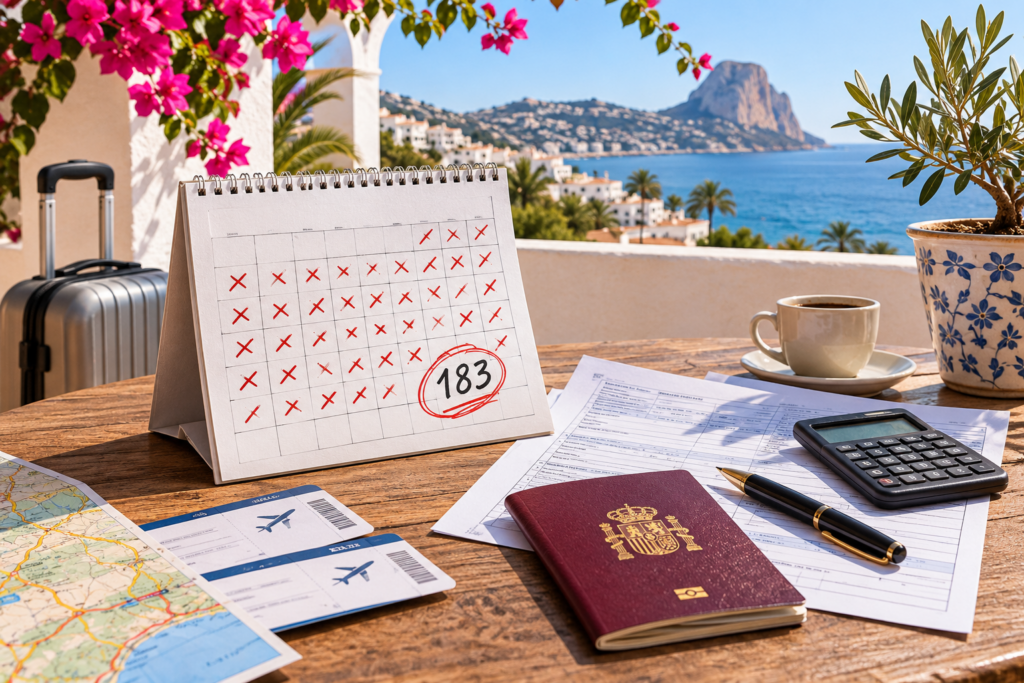
There are certain topics on which, on the Costa Blanca, everyone suddenly becomes an expert. The 183-day rule is undoubtedly one of them. Over coffee in Dénia, at dinner in Altea or amongst neighbours in Moraira, people count the days they’ve spent there, compare their places of residence and devise astonishing strategies to keep the Spanish tax authorities at arm’s length. Particularly popular is the idea that all you need to do is leave the country for a few days at the right time, keep your main residence abroad or do without the green ‘Residencia’ card. That, they say, is all it takes to avoid tax liability.
It’s not quite that simple. This is because the Spanish tax authority, the Agencia Tributaria, is not solely interested in how many days someone spends on the Costa Blanca. A person’s financial and family circumstances can also be decisive.
Under Article 9 of the Spanish Income Tax Act (Law 35/2006), a person is generally regarded as resident for tax purposes if they spend more than 183 days in Spain during a calendar year. The relevant period is the calendar year from 1 January to 31 December – not just any 12-month period. Anyone who exceeds the 183-day threshold therefore generally fulfils a key criterion for Spanish tax residency. However, tax residency may also apply in the case of a shorter stay. This is because the law takes further criteria into account, in particular the centre of economic interests. And this is precisely where the misunderstandings begin.
The most popular myths about the 183-day rule – and what’s actually true
One of the most popular ideas is to travel to France shortly before the 183 days are up, spend a few days there and then return to the Costa Blanca. The problem is that the 183-day rule does not work like a stopwatch that is reset every time you leave the country. The periods of stay within a calendar year are added together. Furthermore, so-called occasional absences, i.e. sporadic absences, are taken into account in the calculation, unless tax residency in another country is duly proven. A weekend trip therefore does not reset the calculation.
182 days in Spain, the rest of the year elsewhere – is that all there is to tax planning? Not necessarily.
In addition to the length of stay, Spanish tax law also takes into account where the centre of economic activities or interests is located. For example, anyone who carries out the substantial part of their economic activities from Spain may be considered a tax resident even if they have stayed for fewer than 184 days. Family circumstances also play a role: if the spouse (provided they are not legally separated) and any dependent minor children habitually reside in Spain, there may be a rebuttable presumption of tax residence, subject to the statutory conditions. A stay of 182 days is therefore no guarantee of not being tax resident in Spain.
This misconception also persists. Yet the ‘residencia’ (residence permit) and tax residency are two different things. The green ‘Residencia’ card confirms the registration of residence for EU citizens and nationals who are entitled to it. However, it does not, on its own, determine where income must be taxed. This also applies to the Permanent residence, the right of permanent residence, which is generally acquired after five years of lawful residence. Conversely, a person may already be resident in Spain for tax purposes without having completed the required residence registration.
We explain which documents are actually required for registration in this article Residence on the Costa Blanca: Application, documents and deadlines.
An entry in the register of residents in one’s home country is not a free pass. What matters is not simply the address stated on a document, but what the actual circumstances are. Anyone who continues to own a flat in Germany, the Netherlands, Belgium or another country may still be considered a tax resident in Spain. The situation becomes more complicated if both countries consider a person to be tax resident on the basis of their respective regulations. In such cases, the provisions of the relevant double taxation agreement may come into play. Factors such as a permanently available home, personal and economic ties, and habitual residence may all play a role. A second home alone does not, therefore, solve the problem.
The source of the money does not automatically determine tax residency. Anyone who is tax resident in Spain is, in principle, liable for Spanish income tax (IRPF) on their worldwide income. This may include foreign pensions, salaries, rental income and investment income. However, this does not mean that every item of income is subject to double taxation. Double taxation agreements set out which country is entitled to tax specific types of income and how double taxation can be avoided or reduced. The rules vary, particularly in the case of foreign pensions, depending on the country of origin and the type of pension.
We explain more about this in our article Retirement on the Costa Blanca: Taxes and health insurance.
The idea that, without an entry stamp, no one can verify a person’s stay is also risky. As part of a tax investigation, the Agencia Tributaria may take various pieces of information into account to assess actual periods of residence and financial circumstances. These may include, for example, travel documents, documented stays, bank and contract details, or other suitable supporting evidence. When determining the number of days spent in the country, the Spanish tax authorities distinguish between proven days of presence, days of presence inferred from the circumstances, and, where applicable, sporadic absences to be taken into account. Anyone who regularly commutes between several countries should therefore keep clear and verifiable records of their actual stays.
Case 1: The couple with two homes
A couple spend five months on the Costa Blanca and the rest of the year in their home country. That is still where the centre of their lives is, and their tax residency can be verified accordingly.
Simply owning a property in Spain does not automatically make the couple Spanish tax residents. However, other tax obligations may apply in Spain, for example as a result of property ownership.
Case 2: The entrepreneur with 150 days’ stay
An entrepreneur is officially resident abroad, but spends a significant part of the year in Spain. He conducts his main business activities from his home on the Costa Blanca.
Although he spends fewer than 184 days in the country, Spanish tax residency may arise from the centre of his economic interests.
Both examples illustrate why a simple calendar-based calculation is not sufficient. Tax classification depends on the actual circumstances.
The situation becomes particularly difficult for people who live, work or earn income in several countries. If two countries consider a person to be a tax resident under their respective national regulations, it must be determined whether a double taxation agreement applies and, if so, to which country residency is attributed under that agreement. The Agencia Tributaria describes a step-by-step assessment for this purpose, in which factors such as the permanently available residence and the centre of vital interests play a role. An important document is the certificate of tax residence (Certificate of tax residence) from the relevant tax authority. It serves as proof of your tax status vis-à-vis another country. This is different from a certificate of residence or the Spanish ‘residencia’. Anyone living across borders should therefore not assess their tax status solely on the basis of residence records or entries in the register of residents. What many people overlook is that Spain generally calculates tax on a calendar-year basis
Under Spanish income tax law, there is generally no distinction made for individuals between being a tax resident for half a year and a non-resident for the other half. Tax status is determined in accordance with Spanish domestic law for the calendar year. A change of residence in the middle of the year therefore does not automatically result in two separate Spanish tax periods. However, in the case of international relocations, double taxation agreements and the regulations of the other country may raise additional issues.
What residents on the Costa Blanca really need to bear in mind
Anyone who commutes between Spain and another country should not focus solely on the figure 183. For a reliable assessment, the actual number of days spent in the country, economic activities, family circumstances and, where applicable, tax residence abroad are all relevant factors. It is also important to distinguish between tax residency and specific tax obligations. Even non-residents may be required to pay tax in Spain, for example on certain income from Spanish property.
Our A Guide to Living and Working on the Costa Blanca explains how tax matters relate to the NIE, residence registration and other administrative procedures.
The 183-day rule is therefore not an invitation to get creative with your calendar. A short trip to France might be a nice change of scenery. However, on its own, it is of little use as a tax strategy.
What matters is not the technicalities surrounding the calendar, but the actual living circumstances and the legal criteria for tax residency.
ADVERTISEMENT

