
ADVERTISEMENT
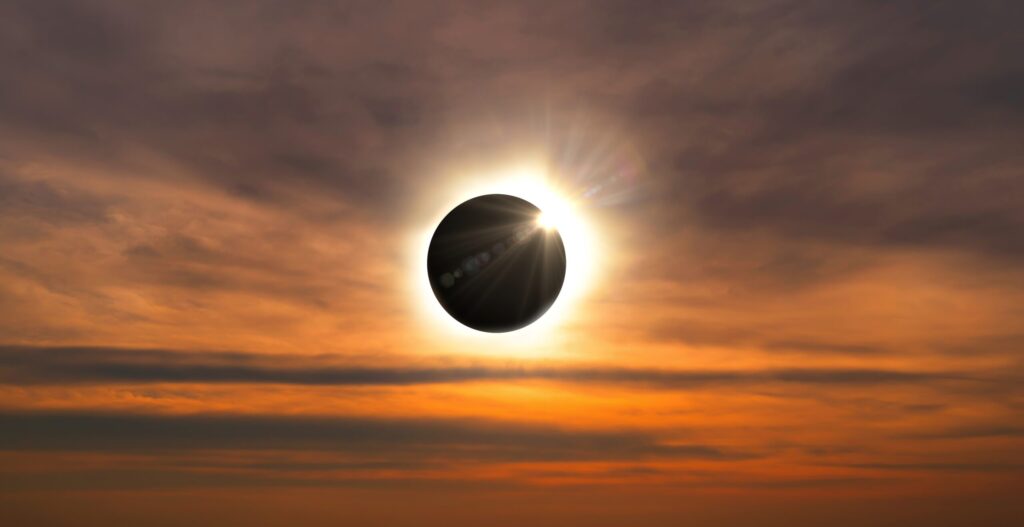
At the University of Alicante in Sant Vicent del Raspeig, the eclipse begins at around 7.40 pm. The eclipse will reach its peak at 8.34 pm. At around 8.59 pm, the sun – still partially obscured – will set. The astronomical end of the eclipse will not occur until 9.25 pm, but it will no longer be visible from there.
For Spain, 12 August is a special day: for the first time in over a century, the path of totality of a solar eclipse will pass over the Iberian Peninsula. It will stretch from north-western Spain through several provinces to València and on across the Mediterranean. The province of Alicante lies just south of this path.
Across the entire Costa Blanca, the sun will be almost completely obscured. The obscuration will be slightly greater in the north than in the south, as Dénia and the Marina Alta are closer to the zone of totality.
In Dénia, Xàbia and the Marina Alta, only an extremely narrow sliver of the Sun will remain visible at the peak of the eclipse. In Calpe, Benissa, Moraira, Altea, Benidorm and Villajoyosa, too, the eclipse will come very close to totality.
For Sant Vicent del Raspeig and the Alicante area, the University of Alicante reports an eclipse coverage of 99.14 per cent. Towards Santa Pola, Guardamar del Segura, Torrevieja, Orihuela Costa and Pilar de la Horadada, the coverage decreases slightly. Even there, the event remains exceptionally clear.
The exact times and values vary by a few minutes depending on the municipality. Using the Instituto Geográfico Nacional’s location viewer, you can look up the start time, peak time, sun’s altitude and direction of the sun for your own location.
It won’t get completely dark on the Costa Blanca. However, the light is likely to appear noticeably dimmer and unusually pale. The solar corona and the so-called ‘diamond ring’ will only be visible within the path of totality.
At its highest point, the sun is only a few degrees above the western horizon. It is therefore over the hinterland – not over the open Mediterranean.
An unobstructed sea view is therefore of little use if houses, mountains or trees on the opposite side block out the sun. On the Costa Blanca in particular, the local topography can determine whether you get to see those crucial few minutes.
A suitable location requires:
Just because a viewpoint is well-known doesn’t automatically mean it’s suitable. The key factor is whether the low-set sun is actually still visible there at around 8.30 pm.
The Generalitat recommends checking the planned viewing location in advance using the official Eclipse Viewer and a digital shadow map. An additional visit a few days before the event will quickly reveal whether any buildings or terrain are blocking the horizon.
A public stargazing event, accompanied by an astronomy talk, has currently been officially announced for the province of Alicante at the University of Alicante in Sant Vicent del Raspeig.
It begins on 12 August at 7.15 pm on the western campus. The university is organising the event in collaboration with the university astronomy association Astroingeo. The programme will include, amongst other things, projections and observations using suitably equipped telescopes.
As yet, no further local monitoring sites have been confirmed in the official lists for Dénia, Xàbia, Calpe, Benidorm, Alicante city, Santa Pola, Torrevieja and Pilar de la Horadada.
This may change in the run-up to the event. Local authorities, cultural centres and astronomical societies may still add to their programmes.
There are currently no comprehensive special regulations in place for the Costa Blanca municipalities regarding road closures, access routes or car parks. Similarly, no details have yet been published regarding dedicated visitor car parks or changes to traffic routes for the event at the University of Alicante. Congestion is expected particularly at small viewing points, castle complexes, nature reserves and higher-altitude locations.
Anyone travelling to a specific location should arrive early, park only in designated areas and keep emergency routes clear.
Shortly before 12 August, you should check the advice issued by your local council, the Policía Local, the DGT and 112 Comunitat Valenciana. If there is a high risk of forest fires, access to nature reserves or woodland areas may be restricted at short notice.
Even the remaining narrow sliver of the Sun can cause permanent damage to the retina. As the eclipse will not be total at any point in the province of Alicante, the glasses must not be removed at any time during the observation.
Suitable solar eclipse glasses must comply with the ISO 12312-2:2015 standard. According to the Generalitat, ordinary sunglasses, X-ray films or very dark welding goggles are not suitable alternatives. Before use, the filter film should be checked for scratches, creases, light patches or other damage.
When purchasing the product, the manufacturer or authorised retailer, instructions for use and safety warnings should also be clearly stated. A generic label such as „Eclipse Glasses“ is not sufficient.
Put the glasses on before looking at the sun. Look away again before taking them off. Children should only watch under direct supervision.
Solar eclipse glasses do not provide protection when looking through binoculars, a telescope or a telephoto lens. These devices concentrate sunlight and require a suitable filter fitted to the front opening or in front of the lens.
Cameras and smartphones should also not be pointed directly at the sun for long periods. A safe alternative is to project the image of the sun indirectly, as is planned at the University of Alicante.
Anyone wishing to see the total eclipse, the solar corona and the diamond ring will need to travel to the path of totality in València or Castellón. The Generalitat has designated several official viewing sites there and, in some cases, has also provided details of capacity, parking facilities, toilets and accessibility. As regards the province of Alicante, it expressly states that totality will not be visible there.
A trip like this should be planned in advance rather than undertaken on a whim. It falls in the middle of August, and in addition to the usual holiday traffic, large numbers of visitors are expected in the totality zone.
The astronomical times have been finalised. Other observation sites, possible traffic arrangements and the weather remain to be confirmed.
In the days leading up to 12 August, readers should therefore check once again:
Particularly when the sun is so low in the sky, even a narrow band of clouds over the hinterland can obscure the crucial minutes.
Date: Wednesday, 12 August 2026
Start of the eclipse: 7.40 pm
Latest: 8.34 pm
Coverage: 99.14 per cent
Sunset: 8.59 pm
Public viewing: from 7.15 pm
Total eclipse: not in the province of Alicante
Eye protection: Solar eclipse glasses in accordance with ISO 12312-2:2015
Note: Further viewing points, events, access arrangements or parking information may be added up until 12 August. The article will therefore be updated as soon as local councils, the Policía Local, the university or the Generalitat publish new information.
ADVERTISEMENT