
ADVERTISEMENT
As at 31 July 2026, 11.00 am
Ceuta is facing an exceptional humanitarian and security situation. Since Thursday, 30 July, thousands of people have entered the Spanish city on the North African coast from Morocco. Many swam past the El Tarajal border breakwater, whilst others waded through the shallow coastal waters or made their way through unsecured sections of the border area.
According to security sources, at least 19 people lost their lives during the attempt. As of Friday morning, there was still no consolidated official figure for the total number of people who had entered the country. Initial estimates by the security forces put the figure at more than 40,000 people, whilst some sources cited even higher figures. However, due to the confusing situation and the large number of voluntary returnees, these figures are provisional.
The Spanish government has deployed additional personnel from the Guardia Civil and the Policía Nacional to Ceuta. Soldiers are helping to secure the border area and monitor key transport routes. On Friday morning, the situation at the El Tarajal crossing was more orderly than the previous day. Nevertheless, small groups continued to reach Ceuta, whilst at the same time many people voluntarily returned to Morocco.
Pressure on the border had already been mounting in the days leading up to the mass arrival. More and more people were attempting to reach Ceuta by sea or by climbing over the border breakwater. As a result, the facilities for adult migrants and unaccompanied minors were already operating at full capacity even before Thursday.
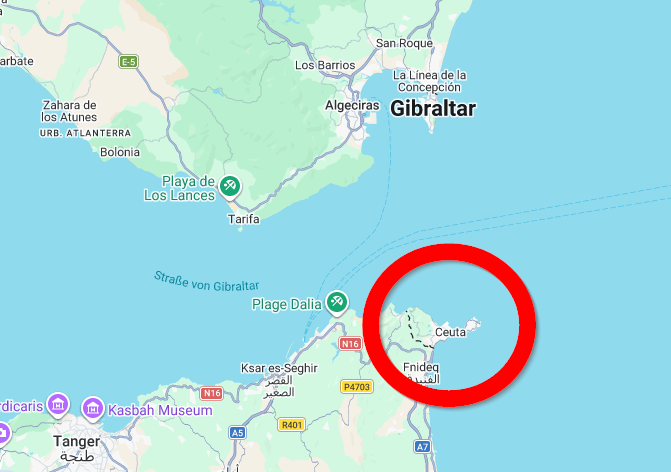
A key factor is its unique geographical location. Ceuta borders directly on the Moroccan town of Fnideq, known as Castillejos in Spanish. The Spanish security forces are able to control the actual border strip. However, roads, access routes, beaches and large gatherings of people on Moroccan territory fall under Rabat’s responsibility.
On Thursday, these pre-border checks were at times insufficient to stem the influx. There is no evidence to suggest whether the Moroccan authorities deliberately allowed this situation to develop or were taken by surprise by its scale. The Spanish government has so far avoided making direct accusations and has instead emphasised its cooperation with Morocco. The Home Office stated that Moroccan security forces had already prevented thousands of irregular border crossings in the days leading up to this.
On Friday, a larger security presence, including vehicles and barriers, was once again visible on the Moroccan side. Moroccan boats were also involved in rescuing people from the water and bringing them back.
The Spanish Ministry of the Interior also holds people-smuggling networks partly responsible for the escalation. It alleges that these networks have exploited a recent ruling by the Tribunal Supremo to give young people in Morocco the impression that they can no longer be returned once they have arrived by sea.
On 8 July, the Supreme Court clarified that the special provision known as „rechazo en frontera“ must not be applied to people who are intercepted on the high seas whilst swimming towards Ceuta or Melilla. In the court’s view, this form of immediate refoulement is limited to border crossings at physical border installations.
However, the ruling does not confer an automatic right of residence, nor does it provide protection against all forms of removal. Instead of an immediate rejection, a standard procedure must be followed. This involves examining, amongst other things, the person’s identity, nationality, age, possible grounds for protection and personal circumstances.
There is no evidence to suggest that misleading portrayals of the judgement actually provided the decisive impetus for the mass movement. The Ministry of the Interior speaks of deliberate exploitation by human traffickers. Added to this are the lack of economic and social prospects for many young people in Morocco, as well as the crucial question of how rigorously the Moroccan authorities monitor their routes of entry.
Deploying soldiers can help stabilise the border region. However, the most labour-intensive work begins after their arrival. Spain must register the people, verify their identities, identify minors and process any applications for international protection.
Madrid and Rabat have announced that they will step up their cooperation and speed up repatriations. The Spanish Ministry of the Interior stated that both countries intend to examine measures to ensure that people who have entered the country irregularly are taken back as quickly as possible.
This does not refer to blanket returns without assessment. Special protection provisions apply to unaccompanied minors. Asylum applications and other possible grounds for protection must be assessed on a case-by-case basis. The Supreme Court’s ruling also requires a regulated procedure for people who have been rescued at sea.
The crisis will therefore not be decided solely at the border. Equally important is how quickly Spain can register those who have already entered the country, provide them with accommodation and make legally sound decisions regarding their future stay. The facilities in Ceuta are not designed to accommodate such a large number of people within a matter of hours.
The Italian Government links the Ceuta crisis to the exceptional regularisation programme carried out by Spain in the spring of 2026. However, no such legal link can be established.
The procedure was aimed exclusively at people who were already in Spain before 1 January 2026 and who, at the time of applying, could prove they had been resident there for at least five months without interruption. The people who have now arrived in Ceuta do not meet these criteria.
Nevertheless, the regularisation may have influenced political expectations and debates regarding Spanish migration policy. However, this does not provide a direct legal incentive for the current border crossings.
France responded on Friday by introducing additional checks at the French-Spanish border. Interior Minister Laurent Nuñez ordered that existing measures be stepped up immediately. In addition, Paris deployed a mobile unit to carry out checks in the hinterland near the border.
This does not mean that the border between France and Spain will be closed. However, travellers should expect more frequent checks of their identity documents, luggage and vehicles, particularly on road and rail routes through Catalonia and the Basque Country.
For residents and holidaymakers on the Costa Blanca, the French announcement will not, for the time being, result in any changes at airports such as Alicante-Elche or Valencia. However, anyone travelling to France by car or train should ensure they have a valid travel document to hand and allow for possible delays at border crossings.
The French reaction shows that the events in Ceuta are no longer viewed solely as a Spanish border issue. The border between Morocco and Ceuta is also an external border of the Schengen Area. Furthermore, special control arrangements apply to travel between Ceuta and mainland Spain.
The reaction from Rome was considerably harsher. Prime Minister Giorgia Meloni and Foreign Minister Antonio Tajani raised the possibility of a temporary suspension of Schengen links with Spain. Tajani justified this by citing the potential risks posed by uncontrolled migration.
However, Italy cannot exclude Spain from the Schengen Area on its own. Individual Member States may, under certain conditions, temporarily reintroduce checks at their internal borders. For Italy, this would primarily involve additional checks on travellers from Spain at airports and ferry terminals. As of Friday morning, no such measures had been decided upon.
Madrid responded with strong criticism and summoned the Italian ambassador. The dispute highlights just how differently EU member states view national decisions on migration – and how quickly this can lead to a conflict over the common right to freedom of movement.
The European Commission has offered Spain additional financial, technical and operational support. This also includes the possibility of reinforcements from the European border agency Frontex. At the same time, Brussels says it is in contact with Morocco and is calling for measures to be taken to prevent further dangerous crossings into Ceuta.
Frontex is already operating in the ports of Ceuta, Algeciras and Tarifa as part of Operation Minerva 2026. Any additional deployment directly at the border would have to be coordinated with Spain.
The crisis will therefore serve as an early stress test for the new European Pact on Migration and Asylum. Its key provisions have been in force since 12 June 2026. Among other things, they provide for more standardised registration, security and asylum procedures at the external borders, as well as support for Member States facing particular pressure.
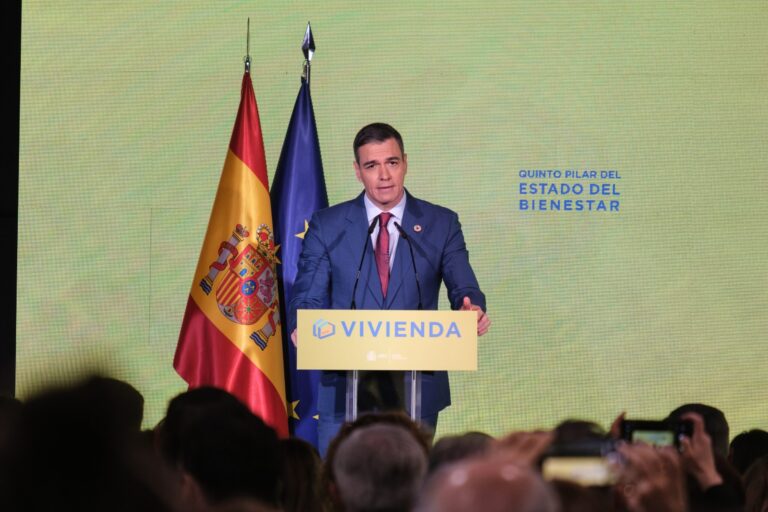
Prime Minister Pedro Sánchez was due to travel to Ceuta on Friday, accompanied by Interior Minister Fernando Grande-Marlaska. The itinerary included a meeting with the security forces at the El Tarajal border crossing, as well as consultations with the regional government, the government delegation, the CETI reception centre and the Red Cross.
At the time of going to press, no detailed new package of measures had yet been announced. What had been confirmed was the deployment of additional police officers and soldiers, closer coordination with Morocco, preparations for repatriation procedures, and the offer of European support.
The key factors now will be whether Morocco maintains permanent control over access to the border, how quickly Spain can register and accommodate those entering the country, and whether other EU Member States introduce their own border controls. For Spain, this is no longer simply a matter of stabilising Ceuta. The crisis affects the functioning of Europe’s external borders and the trust between the Schengen Area states.
ADVERTISEMENT